Category: Wellness After 50

  • Habits That Stick Start With Identity

    Habits That Stick Start With Identity

    I have been thinking a lot about habits that stick lately.

    Not the kind where you make a big plan on Monday, mess up by Wednesday, and decide you already failed.

    I mean the kind of habits that slowly become part of who you are.

    I have been listening to Atomic Habits by James Clear again. I have read it before. I have listened before. However, this time something clicked differently.

    Maybe it is because I am in a different season of life.

    Maybe it is because I am finally understanding that habits are not just about what we do.

    They are also about who we believe we are becoming.

    Why Habits That Stick Start With Identity

    I know how to lose weight.

    I know what foods help me feel better.
    I know movement matters.
    I know protein helps.
    I know consistency works.

    However, knowing what to do is not always the same as becoming the person who does it.

    That has been the piece I am seeing more clearly now.

    For a long time, my weight went up and down because my habits changed for a season, but my identity did not fully change with them.

    I could lose the weight.
    I could follow the plan.
    I could get results.

    But if deep down I still saw myself as someone who always goes back, then eventually I would.

    That is hard to admit.

    However, it is also freeing.

    Because once you see it, you can work on it.

    My Old Identity Kept Me in the Same Cycle

    I used to be over 200 pounds.

    And for a long time, that was part of how I saw myself.

    Lose weight.
    Gain it back.
    Start again.
    Get frustrated.
    Try harder.
    Repeat.

    That cycle can become an identity without us even realizing it.

    It is not just, “I gained weight.”

    It becomes:

    “This is what I do.”
    “This is who I am.”
    “I always go back.”

    And when that belief sits underneath everything, habits feel harder to keep.

    Not because we are lazy.

    Not because we do not care.

    But because we are trying to live from a new routine while still carrying an old identity.

    Losing 80 Pounds Changed More Than My Weight

    After losing 80 pounds, I did change.

    I was no longer the woman who felt stuck in the 200-pound range.

    My identity shifted.

    I started to see myself as a woman who could live in the 150-pound range.

    That may not sound like a big deal to some people, but for me, it was huge.

    It meant I was no longer living from the old story.

    I had proof that change was possible.

    I had proof that I could show up for myself.

    Also, I had proof that small choices repeated over time really do matter.

    That is how habits that stick begin to form.

    They become evidence.

    Now I Am Working on the Next Identity

    My lowest weight was 133.

    I felt great there.
    I felt strong.
    I felt proud of myself.
    I thought I looked awesome.

    Some people told me I looked too thin. Honestly, that can mess with your head too.

    So now, I am not trying to chase skinny.

    I am not trying to prove anything.

    Instead, I am working on becoming the woman who lives around 140 pounds in a healthy, steady, peaceful way.

    Not through obsession.
    Not through punishment.
    Not through starting over every Monday.

    Through identity.

    Through habits.

    Through becoming the kind of woman who takes care of herself because that is who she is.

    The Identity Has to Match the Habit

    This is the part that stands out to me.

    If I want habits that stick, I cannot only say, “I am trying to lose weight.”

    Instead, I need to begin thinking:

    “I am a woman who moves daily.”
    “I am a woman who eats in a way that supports her body.”
    “I am a woman who chooses protein because it helps me feel steady.”
    “I am a woman who does not quit when one day is messy.”
    “I am a woman who keeps promises to herself.”

    That identity matters.

    Because when your identity changes, your choices start to line up with it.

    Not perfectly.

    But more consistently.

    And consistency is what changes a life.

    This Is Not About Perfection

    I still like treats.

    I still have days where I do not eat the way I planned.

    Also, I still have moments where I want the easy thing, the sweet thing, or the comfort thing.

    So this is not about pretending I have it all figured out.

    It is about telling the truth.

    If I want lifelong health, I need lifelong habits.

    And if I want lifelong habits, I need an identity that supports them.

    That is the difference.

    A plan can get you started.

    However, identity is what helps you stay.

    Small Habits Become Evidence

    Every time I move my body, I am giving myself evidence.

    Every time I choose a meal that supports me, I am giving myself evidence.

    When I drink my water, get back on track, pause before eating out of stress, or choose protein first, I am giving myself evidence.

    The evidence says:

    “This is who I am now.”

    Not because I said it once.

    But because I am living it in small ways.

    That is where change becomes real.

    That is where habits that stick become part of your life.

    Maybe This Is Your Reminder Too

    Maybe you are not trying to lose weight.

    Maybe you are trying to become more peaceful.
    Maybe you are trying to move more.
    Maybe you are trying to eat in a way that supports your body.
    Maybe you are trying to stop quitting on yourself.
    Maybe you are trying to believe it is not too late.

    Whatever it is, start with this question:

    Who do I need to become for this habit to feel natural?

    Not perfect.

    Natural.

    Because lasting change is not just about forcing yourself to do better.

    It is about slowly becoming the kind of person who lives differently.

    A Book That Helped Me Think Differently

    One book that has helped me understand habits and identity in a deeper way is Atomic Habits by James Clear.

    A Little Note About Links

    Some links on this page may be affiliate links. That means I may earn a small commission if you choose to purchase through them, at no extra cost to you. I only share things I personally look for, use, or believe may be helpful for simple healthy living.

    I have read it and listened to it before, but this time I am hearing it differently.

    That is the beautiful thing about growth.

    Sometimes you can hear the same truth in a new season, and it lands in a whole new way.

    If you want to check it out, look at the link above.

    Final Thoughts on Habits That Stick

    I am still changing.

    I have changed a lot, but I am still becoming.

    And maybe that is the whole point.

    We do not need to become a whole new person overnight.

    Instead, we keep choosing small habits that agree with the woman we are becoming.

    For me, that means I am no longer the woman who always goes back.

    I am becoming the woman who keeps going.

    One choice.
    One habit.
    One identity shift at a time.

  • How to Tell if a Protein Bar Is Actually a Good Choice

    How to Tell if a Protein Bar Is Actually a Good Choice

    Protein bars can be tricky.

    Some look healthy.
    Others taste like dessert.
    And honestly, a few are basically candy bars wearing a wellness outfit.

    I am not here to shame any of it.

    As a woman over 50, a grandma, and someone who cares about health without making food my whole personality, I want simple. I want something I can grab at work, keep in my bag, or have with black coffee and water when life is moving fast.

    But I also want to know this:

    Is this protein bar actually helping me, or is it just a treat with the word protein on the wrapper?

    Let’s make it simple.

    Start With the Protein Math

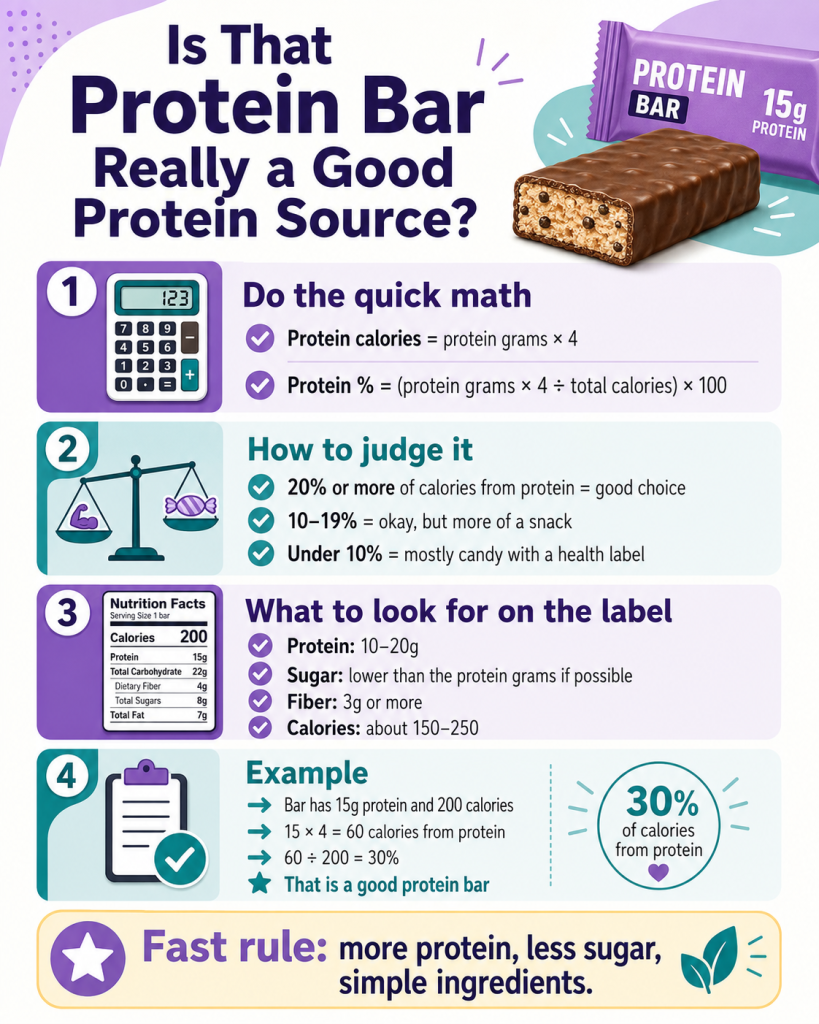
    Here is the quick way to know if a protein bar is truly a good source of protein.

    Every gram of protein has about 4 calories.

    So you take:

    Protein grams × 4 = calories from protein

    Then you divide that by the total calories in the bar.

    Here is an example.

    A bar has:

    • 220 calories
    • 20 grams of protein

    Now do the math:

    20 grams protein × 4 = 80 calories from protein

    Then:

    80 ÷ 220 = 36%

    That means about 36% of the calories come from protein.

    That is a strong protein bar.

    As a simple rule, I like to see 20% or more of the calories coming from protein.

    Look at the Sugar

    Next, check the sugar.

    A bar with 20 grams of protein and 18 grams of sugar may taste good, but it may not feel good later.

    For me, I like to see sugar lower than the protein grams.

    A bar with:

    • 20g protein
    • 1g total sugar

    That is a pretty good sign.

    It does not mean the bar is perfect. It just means the sugar is not taking over the whole snack.

    Watch the Sugar Alcohols

    This is where a lot of people miss it.

    Sugar alcohols are often used to keep the sugar number low. You may see ingredients like erythritol, maltitol, sorbitol, or xylitol.

    They are not automatically bad, but they can bother some stomachs.

    Some people are totally fine.

    Other people may notice:

    • bloating
    • gas
    • stomach cramps
    • bathroom urgency

    So if your protein bar has 7g of sugar alcohols, that may still be okay, but pay attention to how your body feels.

    At this age, body wisdom matters.

    Not every “healthy” food is healthy for your body.

    Check the Fat and Saturated Fat

    Fat is not the enemy.

    We are not doing that old-school diet culture thing anymore.

    But saturated fat is worth looking at, especially if you eat protein bars often.

    A bar with:

    • 7g fat
    • 5g saturated fat

    That is not terrible, but it is something I would rotate.

    I would not panic over it.
    There is no need to throw the bar away.
    Instead, I would simply say, “Okay, this is a sometimes bar, not my only daily protein source.”

    That is how we build habits that last.

    Gluten-Free Matters Too

    In my home, gluten-free is something I pay attention to.

    Not just because gluten-free is popular, but because when someone in your family deals with celiac or gluten sensitivity, labels matter.

    If a protein bar is marked gluten-free, that is a big plus.

    But I still like to check the ingredient list because gluten can hide in places we do not expect.

    Simple reminder:

    Gluten-free does not automatically mean healthy, but it can make a product safer for someone who needs it.

    What I Like to See in a Protein Bar

    Here is my simple checklist:

    • 10–20g protein
    • Low sugar
    • Gluten-free if needed
    • Fiber if your stomach handles it
    • Not too many ingredients you cannot pronounce
    • Calories that make sense for your goal
    • Does not trigger cravings
    • Does not upset your stomach

    That last one matters.

    A bar can look perfect on paper and still not be perfect for you.

    My Real-Life Protein Bar Rule

    Here is how I look at it now:

    If it keeps me full, gives me protein, fits my gluten-free needs, does not bother my stomach, and does not send me looking for more sweets afterward…

    It is a good choice.

    Not perfect.
    Not magical.
    Just useful.

    And honestly, useful wins.

    Especially when you work odd hours, take care of family, help with grandkids, and still want to take care of your own health.

    Protein Bars I’d Look For

    When I am choosing a protein bar, I am not looking for perfect.

    I am looking for something that makes sense for real life.

    For me, that means:

    • higher protein
    • low sugar
    • gluten-free when needed
    • ingredients that work for my body
    • something that keeps me full
    • something that does not upset my stomach

    A little note about links: Some links may be affiliate links. That means I may earn a small commission if you choose to purchase through them, at no extra cost to you.

    A few protein bars I would personally compare are:

    My protein bar rule is simple:

    I look for higher protein, low sugar, gluten-free when needed, and ingredients that work for my body.

    A protein bar is not meant to replace real food all day long.

    But when life is busy, when you are at work, running errands, helping family, or just need something quick, the right protein bar can be a helpful grab-and-go option.

    Not perfect food.

    Just a useful choice.

    And sometimes useful is exactly what helps us stay consistent.

    Final Thoughts

    A protein bar can be a helpful tool.

    It does not need to replace real food.
    Also, it does not need to be perfect.
    And it definitely does not need to become another thing to obsess over.

    Just learn how to read the label.

    Look at the protein.
    Check the sugar.
    Notice the sugar alcohols.
    Watch the saturated fat.
    Check for gluten-free if that matters in your home.

    Then ask yourself the most important question:

    How do I feel after I eat it?

    That answer matters more than the front of the wrapper.

    Health after 50 is not about being perfect.

    It is about becoming wiser, one choice at a time.

    A Little Note About Links

    Some links on this page may be affiliate links. That means I may earn a small commission if you choose to purchase through them, at no extra cost to you. I only share things I personally look for, use, or believe may be helpful for simple healthy living.

  • Simple Things That Make Healthy Living Easier After 50

    Simple Things That Make Healthy Living Easier After 50

    .

    This post may contain affiliate links. As an Amazon Associate, I earn from qualifying purchases.

    Healthy living after 50 does not have to be extreme, expensive, or complicated.

    In fact, I think a lot of women are tired of being told they need a perfect plan, a perfect body, or a perfect routine to finally feel good. That kind of pressure gets old fast.

    What helps more is creating a life that makes better choices easier.

    For me, healthy living is not about chasing perfection. It is about simple things that support me day by day. The little habits, tools, and reminders that help me care for my body, my mind, my home, and my peace.

    Some of these things are practical. Some are encouraging. Some just make life feel a little more manageable. But together, they help create an environment where feeling better becomes more doable.

    And that is really the goal.

    Not harder.
    Just simpler and more sustainable.

    1. A Water Bottle I’ll Actually Use

    I know this sounds simple, but that is the point.

    Drinking more water is easier when water is right in front of me. If I have to think too hard about it, I am less likely to do it.

    A water bottle on the counter, beside my chair, in the car, or near my workout space helps me remember without making it a big project.

    Healthy habits often work better when they are visible.

    Not hidden.
    Not complicated.
    Not saved for Monday.

    Just right there where real life happens.

    2. A Mug That Helps Me Slow Down

    There is something about holding a warm mug that reminds me to pause.

    For me, coffee is not just coffee. It is often a moment to breathe, think, pray, or reset my mind before the day gets moving.

    Healthy living after 50 is not only about food and exercise. It is also about how we handle stress, how we speak to ourselves, and how often we allow ourselves to slow down.

    Sometimes a quiet moment with coffee, tea, or protein coffee can become a small routine that helps us feel grounded.

    And honestly, we need more grounded.

    Not more pressure.

    3. Books That Keep My Mind Growing

    I love having books around me.

    Books have helped me grow in faith, mindset, leadership, and life. I have always loved authors like John Maxwell for leadership and personal growth, and Joyce Meyer for faith, mindset, and everyday encouragement.

    After 50, we are not done learning.

    We are not done growing.

    We are not done becoming.

    A good book can remind us that our thoughts matter. Our words matter. Our habits matter. The direction of our life can still change one decision at a time.

    I do not read because I have everything figured out. I read because I want to stay teachable.

    That matters.

    4. A Kitchen That Makes Better Choices Easier

    One thing I have learned is this: your environment matters.

    If the kitchen is full of things that pull me away from how I want to feel, then I am going to have to fight harder. But when I make the better choice easier to see and easier to grab, I give myself support.

    That might look like keeping simple protein options available.

    It might mean having vegetables washed and ready.

    It might mean using glass containers so leftovers are easy to see.

    It might mean having a few gluten-free basics in one spot so the kitchen feels less stressful.

    Small setup changes can make a big difference.

    Healthy living is not always about more discipline. Sometimes it is about making the next right choice easier.

    5. Simple Movement Tools

    Movement does not have to take over your life.

    I am a big believer in simple movement. Squats in the kitchen. Pushups. A plank. Walking. Stretching. Stairs. A few minutes here and there.

    You do not need to turn your home into a gym to start moving your body.

    A few simple tools can help, but the truth is, your body is already enough to begin.

    A small set of hand weights, resistance bands, a good pair of sneakers, or even just a clear space on the floor can help you build strength little by little.

    After 50, I do not move because I hate my body.

    I move because I want to keep using it.

    That is a very different energy.

    6. A Home That Supports Peace

    Healthy living is also about the home we are living in every day.

    The products we use, the clutter we see, the smells we breathe in, the routines we build — all of it can either add stress or support peace.

    This does not mean we have to change everything overnight.

    It may start with one simple swap.

    One cleaner product.
    One less toxic choice.
    One cleared counter.
    One calming corner.
    One basket for the things that keep getting scattered.

    The older I get, the more I realize peace matters.

    A healthier home does not have to be perfect. It just needs to support the woman you are becoming.

    7. A Mindset of Progress, Not Perfection

    This may be the biggest one.

    Healthy living after 50 gets easier when we stop demanding perfection from ourselves.

    Perfection makes women quit.

    Progress keeps women moving.

    There will be days when you eat great and days when you do not. Days when you move your body and days when you need rest. Days when you feel strong and days when you feel like you are starting over again.

    That does not mean you failed.

    It means you are human.

    The goal is not to live perfectly. The goal is to keep returning to the habits that help you feel better.

    One meal.
    One walk.
    One glass of water.
    One prayer.
    One better thought.
    One small choice.

    That is how change becomes a lifestyle.

    Final Thoughts

    Healthy living after 50 does not have to be loud, strict, or overwhelming.

    It can be simple.

    A water bottle you actually use.
    A mug that helps you pause.
    Books that grow your mind.
    A kitchen that supports better choices.
    Movement that fits your life.
    A home that feels more peaceful.
    A mindset that gives you room to keep going.

    That is the kind of healthy living I want.

    Not perfect.
    Not extreme.
    Not all-or-nothing.

    Just simple things that make feeling better more doable.

    And that counts.