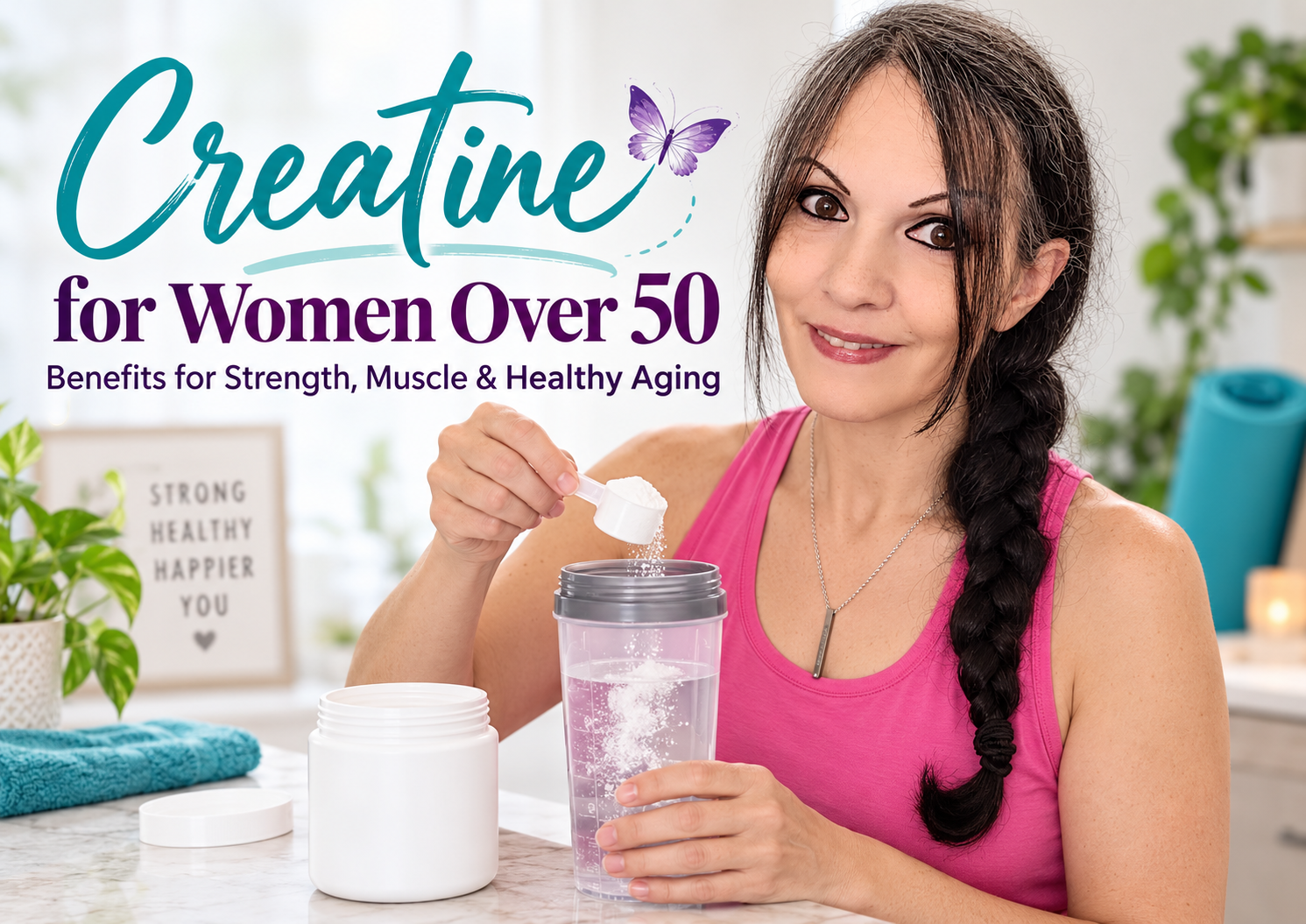
When you hear the word creatine, what comes to mind?
For years, I associated creatine with bodybuilders, heavy weights, and people spending hours at the gym.
I certainly didn’t think of women in their 50s, 60s, and beyond.
But the more I’ve learned about healthy aging and maintaining muscle, the more I’ve realized that creatine deserves a closer look.
At 61, my goal isn’t to be skinny. My goal is to be strong, healthy, and capable of doing the things I love for years to come.
I’ve exercised on and off for much of my life, so strength training isn’t completely new to me. But recently, I’ve become much more intentional about building and maintaining muscle.
I started taking creatine monohydrate in August, and I’ve been taking 5 grams every day while continuing my strength training at home.
I’ve noticed muscle definition, especially in my arms. Is that from lifting weights, creatine, or both?
Most likely, my training deserves much of the credit, with creatine potentially helping me get more out of it.
Let’s talk about what creatine actually does and why women over 50 might want to understand it.
What Is Creatine?
Creatine is a natural compound our bodies make from amino acids. It’s also found in foods such as meat and fish.
Most of our body’s creatine is stored in our muscles, where it helps provide quick energy during activities such as lifting weights, climbing stairs, or doing short bursts of intense exercise.
Creatine monohydrate is the most widely researched form available as a supplement.
And despite what many people think, it isn’t a steroid or a hormone.
It’s simply one tool that may support muscle performance.
Why Is Creatine Important for Women Over 50?
As we age, we naturally become more vulnerable to losing muscle mass and strength.
This age-related muscle loss can affect everyday life in ways we might not think about until simple activities become more difficult.
Carrying groceries, getting up from the floor, walking stairs, playing with grandchildren, and maintaining our balance all require muscle strength.
And here’s something I believe strongly:
We shouldn’t wait until we’re struggling to make strength a priority.
Strength training, adequate protein, proper nutrition, and consistent movement are the foundation.
Creatine may offer additional support.
5 Potential Benefits of Creatine After 50
1. Creatine May Help Improve Muscle Strength
This is one of the best-supported benefits.
Creatine helps your muscles replenish energy during challenging exercises.
When combined with resistance training, research suggests it can provide modest additional improvements in strength for older adults.
That doesn’t mean taking creatine alone will give you stronger arms.
You still have to challenge your muscles.
But it may help you get a little more out of the work you’re already doing.
2. Creatine May Support Muscle Development
Muscle isn’t just about appearance.
Muscle helps support our metabolism, movement, and physical independence.
Creatine may help support muscle development when paired with strength training, although research doesn’t consistently show extra muscle growth in every older adult.
For me, it’s about maintaining the muscle I’ve worked to build over the years.
I don’t want to lose strength simply because I’m getting older.
3. Creatine May Help With Workout Performance
Have you ever reached the end of a set of exercises and felt like you had absolutely nothing left?
Creatine supports the energy system your muscles use for short, demanding efforts.
That can sometimes mean completing another repetition or maintaining better performance during your workout.
Over weeks and months, those small improvements can add up.
And no, you don’t have to be lifting extremely heavy weights to benefit from strength training.
Consistency and proper form matter more than trying to impress anyone.
4. Creatine May Support Brain Health
This is an area of research I find especially interesting.
Scientists are studying whether creatine can support memory, attention, and other aspects of cognitive performance as we age.
Some findings are encouraging.
However, the research is still developing, and we don’t yet have enough evidence to say that taking creatine will prevent cognitive decline or improve memory for everyone.
It’s an interesting potential benefit, but not something I would promise.
5. Creatine May Help Support Healthy Aging
For me, this is the bigger picture.
I want to stay active.
I want to maintain my independence.
I want to enjoy my grandchildren and continue doing everyday activities without feeling limited by a lack of strength.
Creatine isn’t a magic solution for aging.
But alongside regular strength training and other healthy habits, it may be a useful addition.
How Much Creatine Should Women Over 50 Take?
A commonly studied maintenance amount is 3–5 grams of creatine monohydrate daily.
I personally take 5 grams every day, including the days I don’t work out.
You don’t have to take creatine immediately before exercise.
Consistency matters more than timing because creatine works by gradually increasing the amount stored in your muscles.
You also don’t need to start with a high loading dose.
Taking a regular daily amount can build muscle creatine stores over several weeks.
Anyone with kidney disease or other significant medical concerns should speak with their healthcare provider before beginning supplementation.
How Long Does Creatine Last in Your Body?
This was something I wanted to understand myself.
Creatine isn’t like drinking a cup of coffee and feeling an immediate burst of energy.
Instead, your muscles gradually build up creatine stores with consistent supplementation.
Once those stores are elevated, they remain available to help support muscle energy production.
If you stop taking creatine, your elevated muscle stores generally return toward their previous levels over about four to six weeks.
That’s why regular daily use is more important than choosing a perfect time of day.
How Long Can You Leave Creatine Mixed in Water?
Another common question is whether creatine needs to be consumed immediately after mixing it with water.
Creatine monohydrate slowly breaks down into creatinine after being dissolved.
However, that process isn’t immediate.
For everyday use, mixing it and drinking it within a few hours is a simple approach.
If you’re preparing a drink to take to work, keeping it refrigerated or cool is a good idea.
Avoid leaving it sitting in a hot car or warm environment for long periods.
Freshly mixed is ideal, but there is no need to panic if you don’t drink it right away.
Does Creatine Make You Gain Weight?
This is particularly important for women who are watching the number on the scale.
Creatine can increase the amount of water stored inside your muscles.
That means some people notice a small increase in body weight when they begin taking it.
That increase doesn’t automatically mean you’ve gained body fat.
I’ve spent enough years paying attention to the scale to know how easily a number can affect our mindset.
But the scale doesn’t tell the entire story.
Your strength, muscle definition, measurements, energy, and how you feel matter too.
If you’re interested in understanding why the scale sometimes changes unexpectedly, read my article:
Why the Scale Goes Up After 50: Understanding Water Weight and Glycogen
Is Creatine Safe for Women Over 50?
Creatine monohydrate is one of the most extensively studied sports supplements.
Research generally supports its safety at typical daily amounts for healthy adults.
However, that doesn’t mean it’s appropriate for everyone.
Some people experience bloating or digestive discomfort, especially with larger doses.
Anyone with kidney disease, abnormal kidney function, or relevant medical concerns should discuss creatine with their healthcare provider.
Quality matters, too. Choose a reputable product, preferably one that has undergone independent third-party testing.
And remember, supplements should support healthy habits, not replace them.
My Personal Experience With Creatine and Strength Training
I’ve been exercising on and off for years, so I’ve had muscle definition before.
But this season of my life feels different.
I’m not exercising because I’m unhappy with my body.
I’m exercising because I want to take care of it.
I’m lifting weights at home three days a week, working on my arms, legs, and overall strength.
Some workouts feel easier than others. Some days I have more energy. And some days I need to adjust.
That’s real life.
I started taking 5 grams of creatine daily in August.
I’ve noticed definition in my arms, but I can’t honestly say how much is from creatine and how much is from my training.
And that’s okay.
I don’t need to give a supplement credit for what consistency, effort, and years of movement have helped me build.
Creatine may be helping, but I’m the one showing up for those workouts.
Do You Really Need Creatine After 50?
No. Creatine isn’t something every woman must take.
You can absolutely build strength without it.
What matters most is finding habits you can maintain.
Move your body.
Challenge your muscles.
Eat nourishing food.
Get adequate protein and rest.
And be willing to learn about tools that might support your goals.
If you’re new to strength training, you might also enjoy:
Building Muscle to Be Strong as We Age
Final Thoughts: Strong, Not Skinny
One thing I’ve learned over the years is that our health journey changes as we age.
At one time, I focused far too much on what the scale said.
Today, I care much more about what my body can do.
Can I lift what I need to lift?
Can I move comfortably?
Am I maintaining my strength?
Am I taking care of the body I have instead of constantly trying to make it smaller?
Those are the questions that matter to me.
Creatine may be one useful piece of the puzzle.
But it’s not the foundation.
The foundation is showing up for yourself, building sustainable habits, and understanding that being strong after 50 is something worth working toward.
And personally, I think that’s a much better goal than chasing a number on the scale.
With encouragement,
Alice McCarthy
Disclaimer: This article shares my personal experience and general educational information. It is not medical advice. Always speak with a qualified healthcare professional about supplements and individual health concerns.