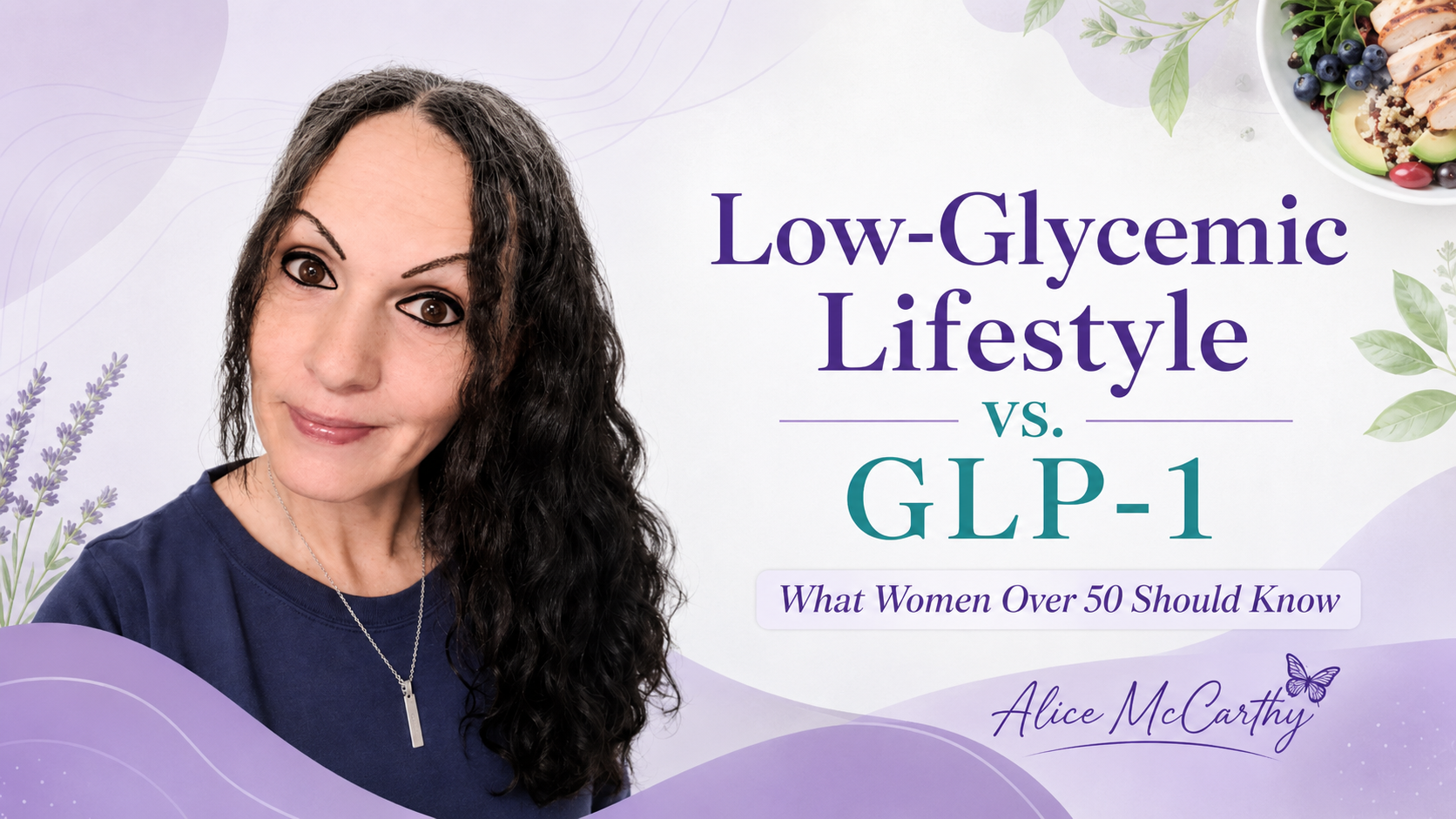
Low Glycemic vs GLP-1: What Is the Difference?
GLP-1 medications are everywhere right now. Some women are getting great results. Others are concerned about side effects, cost or what may happen if they stop taking them.
At the same time, many women are improving their health through food, movement and better daily habits.
It can feel like we are supposed to choose a side.
Medication or lifestyle.
Natural or medical.
Doing it the “right way” or taking the “easy way.”
I do not believe it needs to be that way.
A low-glycemic lifestyle and GLP-1 medication are not the same thing, but they do not have to be enemies either.
How a Low-Glycemic Lifestyle Works
A low-glycemic lifestyle focuses on foods that generally have a gentler effect on blood sugar.
For me, that means building meals around protein, vegetables, fiber, healthy fats and lower-glycemic carbohydrates.
I do not count calories.
I eat to hunger and focus on foods that help me feel steady, satisfied and in control.
This is not about fearing carbohydrates or eating as little as possible. It is about making choices that work well with my body.
Since following this lifestyle, I have noticed that much of my food noise has quieted down.
I am not constantly thinking about cookies, cakes and candy.
Now, let me be real.
I remember how good those foods taste. I also know myself well enough to understand that one cookie can sometimes lead to more—or even the whole package.
That is not weakness.
That is knowing myself and making choices that work with what I know.
What Is a GLP-1?
GLP-1 medications can affect appetite, fullness, digestion and blood-sugar control.
They may help some people:
- Feel less hungry
- Become full sooner
- Experience less food noise
- Improve blood-sugar control
- Lose a meaningful amount of weight
These are real medications used for real medical reasons.
Taking one is not cheating.
For some people living with obesity, type 2 diabetes or certain weight-related conditions, a GLP-1 may be an appropriate tool.
That decision belongs between the individual and a qualified healthcare professional.
However, medication does not automatically teach someone how to build a balanced meal, protect muscle or create habits that last.
That is why lifestyle still matters.
The Biggest Difference
A low-glycemic lifestyle is something you practice.
A GLP-1 is something you take.
One builds daily habits. The other changes certain signals within the body.
Both may affect hunger, blood sugar and weight, but they work differently.
Here is how I see it:
Lifestyle is the foundation. Medication may be an additional tool when it is medically appropriate.
Even when someone uses a GLP-1, she still needs protein, water, movement and strength-building activity.
The medication may make some choices easier, but it does not make healthy habits unnecessary.
No matter which approach someone chooses, lasting results still depend on the habits we practice repeatedly. I shared more about this in my post on building healthy habits that stick.
Is Using a GLP-1 Cheating?
No.
We need to stop acting as though someone earns a prize for struggling the hardest.
Taking medication is not a moral failure.
Choosing not to take medication does not make someone better than someone who does.
Some women may need medical support. Others may find that changing how they eat reduces hunger and cravings without medication.
There is room for both stories.
Why Muscle Matters After 50
For women over 50, the goal cannot only be making the number on the scale smaller.
We also need to protect our strength.
That means eating enough protein and including some type of resistance movement.
It does not have to be complicated.
Wall push-ups, squats, modified planks, resistance bands or light weights all count.
Strong matters.
Energy matters.
Being able to climb stairs, carry groceries and keep up with the grandchildren matters.
Health is bigger than being smaller.
What Is Working for Me
Right now, I am choosing a low-glycemic lifestyle.
I focus on protein, lower-glycemic foods, simple movement and eating to hunger.
My cravings have changed.
My food noise has quieted.
I feel more in control without feeling like I am constantly fighting myself.
That does not mean my way is the only way.
Your health history, hormones, medications and lifestyle may be completely different from mine.
No two journeys are exactly the same.
Helpful Low-Glycemic Resources
I do not think we need a shelf full of diet books. A few useful resources are enough.
Low-GI and Gluten-Free Guidance
The New Glucose Revolution: Low GI Gluten-Free Eating Made Easy by Jennie Brand-Miller, Kate Marsh and Philippa Sandall includes low-GI education, gluten-free guidance and recipes.
View the Jennie Brand-Miller book on Amazon
A Simple No-Calorie-Counting Approach
Living the G.I. Diet by Rick Gallop uses a simple traffic-light system for food choices.
I like that because I do not count calories either. I prefer lower-glycemic foods, eating to hunger and building a lifestyle I can continue.
View Living the G.I. Diet on Amazon
A Quick Kitchen Reference
A laminated glycemic-index chart can be helpful when comparing foods or planning meals.
I would use it as a guide, not as a list of “good” and “bad” foods.
View a Glycemic Index Reference Chart on Amazon
As an Amazon Associate, I earn from qualifying purchases. This does not change the price you pay.
My Honest Bottom Line
I do not believe women should be shamed for using GLP-1 medication.
I also do not believe medication replaces learning how to care for ourselves.
A low-glycemic lifestyle may be enough for some women. Others may benefit from medication along with lifestyle changes.
The best choice is the one that is safe, medically appropriate and sustainable for your real life.
Know your body.
Know your patterns.
Ask good questions.
Then build habits that will still matter after the excitement of a new plan wears off.
Because the goal is not simply to lose weight.
The goal is to create a healthier life you can actually keep living.
This post shares my personal experience and is for general educational purposes only. It is not medical advice. Speak with a qualified healthcare professional before beginning, stopping or changing any prescription medication.
Leave a Reply